Five Climate Metrics Every Board Should Track
Climate oversight is now a board-level responsibility. These five metrics turn a vague commitment into something directors can actually govern.
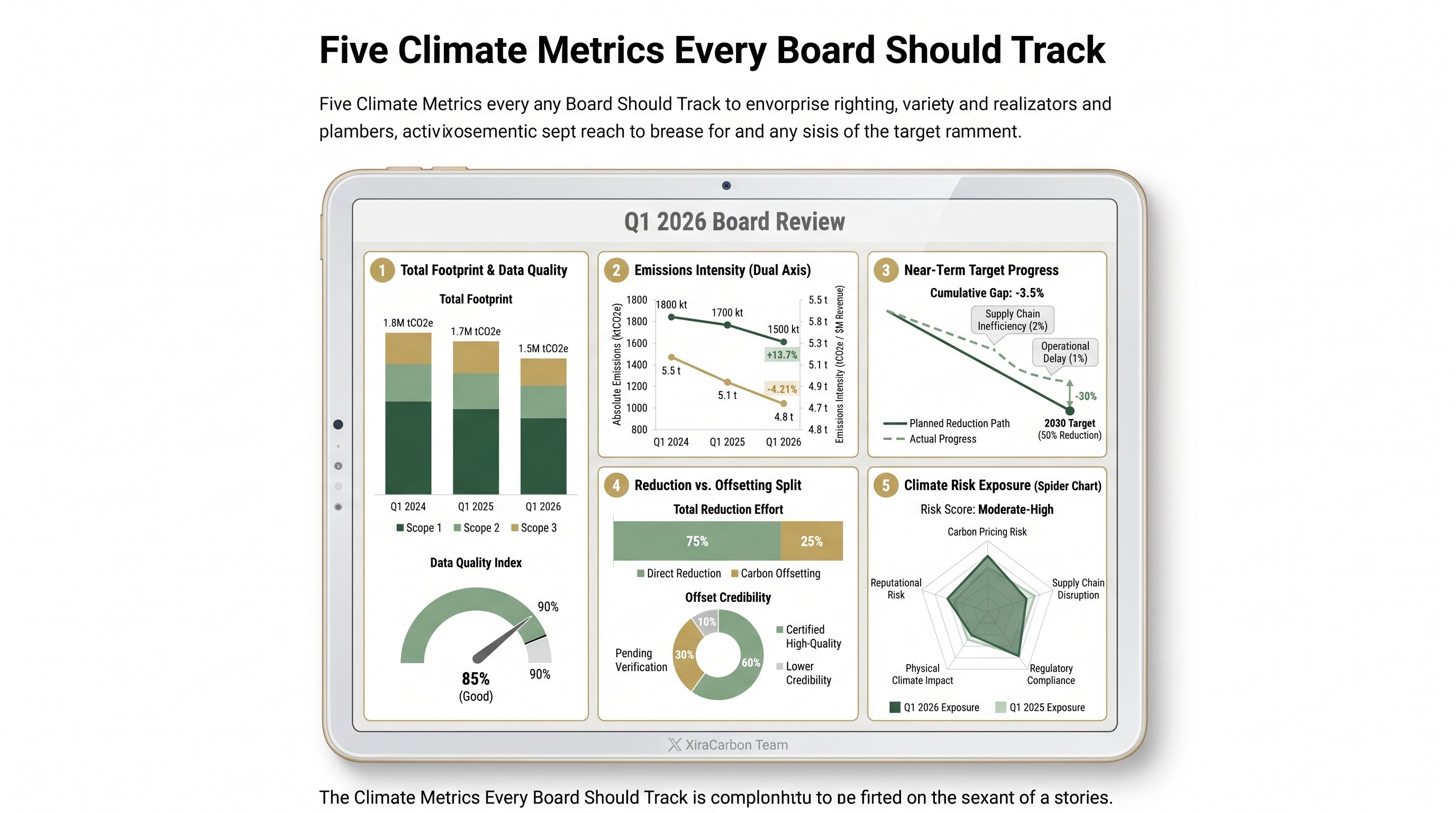
Climate is no longer just an operational issue. Regulators, investors, and customers
now expect boards to own it, the same way they own financial performance. But oversight
only works if directors are looking at the right numbers. These five metrics turn a
vague net-zero commitment into something a board can actually govern.
## 1. Total footprint across all three scopes
The headline number: how many tonnes of CO2e the organisation emits each year across
Scopes 1, 2 and 3. Without a complete, standards-aligned baseline, every other target
is built on sand. Boards should ask how much of the footprint is measured with real
data versus estimates, and whether Scope 3 is included, because for most companies it
is the majority of the total.
## 2. Emissions intensity
Absolute emissions can rise simply because the business is growing. Intensity, such as
tonnes of CO2e per unit of revenue or per product, shows whether the business is
genuinely decarbonising or just standing still while it expands. Track both: absolute
emissions for the planet, intensity for the trajectory.
## 3. Progress against near-term targets
A 2050 goal is easy to ignore for 25 years. Near-term targets, covering the next five
to ten years, are where accountability lives. The board should see actual reductions
against the planned pathway, and a clear explanation wherever the two have diverged.
## 4. The split between reduction and offsetting
Not all "carbon neutral" claims are equal. Directors should know how much of the
progress comes from genuinely cutting emissions versus buying offsets. A credible plan
reduces first and offsets only the residual it cannot yet eliminate.
> If reductions are flat and offsets are doing the heavy lifting, that is a governance
> risk, not a climate achievement.
## 5. Climate risk exposure
Finally, climate is a source of financial risk: carbon pricing, supply-chain
disruption, changing regulation, and shifting demand. The board should see how exposed
the business is, and what the transition plan does to reduce that exposure over time.
## Turning metrics into oversight
These five numbers give a board a real handle on climate, the same way a P&L gives it
a handle on performance. Reviewed every quarter, they move climate from an annual
report footnote to an active part of governance.
Want help building the baseline and reporting that make these metrics trustworthy?
[Talk to our team](/contact).